
When most people think about a clutch, they imagine a manual transmission — the pedal you press to shift gears. So it might come as a surprise to learn that automatic transmissions also have clutches, just not the same kind you find in a manual vehicle. Understanding how they work helps explain the magic behind smooth, effortless gear changes in automatic cars.
Do Automatic Transmissions Have Clutches?
The Difference Between Manual and Automatic Clutches
The clutch, which connects and disconnects the engine from the transmission in a manual gearbox, is a mechanical device. When you press the clutch pedal, it disengages the engine from the wheels, allowing you to change gears manually. Once you release the pedal, power flows from the engine to the transmission again.
Automatic transmissions, however, don’t require the driver to engage or disengage a clutch manually. Instead, they rely on hydraulic systems and internal clutches to perform the same job automatically. The goal is the same — to control how power transfers from the engine to the wheels — but the method is entirely different.
Torque Converter: The Automatic Equivalent of a Clutch
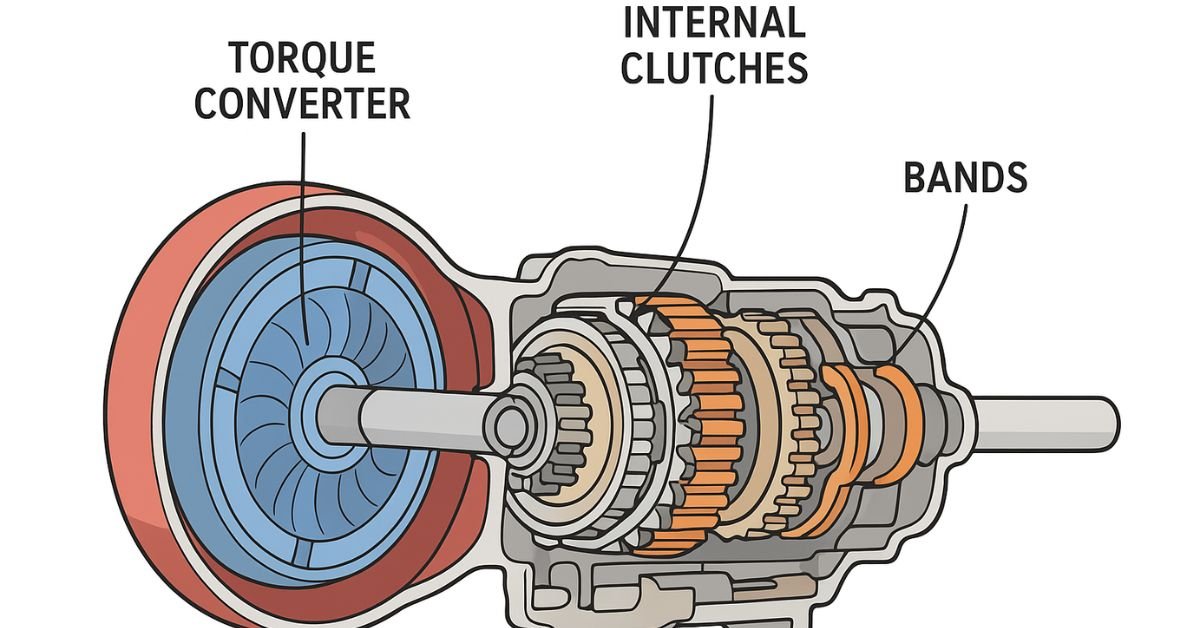
In a traditional automatic transmission (also called a torque converter automatic), there’s no single clutch pedal or manual friction plate. Instead, these systems use a torque converter to manage power flow.
The fluid coupling that joins the engine and transmission is called a torque converter. It uses transmission fluid to transfer torque smoothly from the engine to the drivetrain. This fluid dynamic action eliminates the need for a driver-operated clutch.
The torque converter allows the car to stay in gear even when idling. For example, when you stop at a traffic light, the engine continues running, but the car doesn’t stall — thanks to the torque converter allowing slight slippage between the engine and transmission.
However, inside the transmission, there are still clutches — just designed differently.
Internal Clutches and Bands Inside Automatic Transmissions
Even though automatics use a torque converter, they also have multiple internal clutch packs and bands that work together to change gears. These components are responsible for engaging and disengaging different sets of gears automatically.
Here’s how it works:
- Automatic transmissions have planetary gear sets, which can provide different gear ratios.
- To change gears, hydraulic pressure (from transmission fluid) activates clutch packs and bands.
- These clutch packs hold certain gears stationary while allowing others to rotate, creating different gear ratios for smooth acceleration.
So, while there’s no “pedal” for the driver, internal clutches still play a vital role in how an automatic transmission operates.
Dual-Clutch Transmissions (DCT)
Some modern vehicles use a system known as a dual-clutch transmission (DCT). As the name suggests, it uses two separate clutches — one for odd-numbered gears (1, 3, 5) and another for even-numbered gears (2, 4, 6).
Unlike a torque converter, DCTs are more mechanically similar to manual transmissions but controlled electronically. They can shift gears faster and more efficiently, which is why they’re often found in performance vehicles. Although there’s no clutch pedal, dual-clutch systems definitely have clutches inside — two of them, in fact.
Continuously Variable Transmissions (CVTs)
Another type of automatic system is the continuously variable transmission (CVT). Instead of gears and clutches, CVTs use a belt and pulley system to provide seamless acceleration. Most CVTs don’t use traditional clutches, but some hybrid systems may include small clutch mechanisms to manage engine start/stop functions or power transitions between the engine and electric motor.
So, Do Automatics Have Clutches?
The simple answer is yes — but not in the way most people think.
- Traditional automatics use a torque converter and internal clutch packs.
- Dual-clutch transmissions use two clutches, electronically controlled.
- CVTs may or may not use clutches, depending on their design.
Every type of automatic system uses some form of clutch mechanism to manage power flow and gear changes — it’s just hidden inside the transmission rather than being controlled by the driver.
Final Thoughts
Automatic transmissions have come a long way in design and technology. While you won’t find a clutch pedal in an automatic car, the principle of the clutch still exists inside — it’s just automated. These systems rely on intricate hydraulic and electronic controls to shift gears smoothly, making driving effortless for most people.
So the next time you glide through traffic in your automatic car, remember — even though you’re not pressing a pedal, your car’s transmission is still using clutches behind the scenes to keep everything running smoothly.