
Keeping your automatic transmission cool is one of the most important factors in maintaining long-term reliability. Excessive heat is the number one enemy of transmission fluid, seals, and internal components. That’s why many vehicles—especially trucks, tow rigs, off-road builds, and performance cars—use a standalone transmission cooling fan. One of the most common questions people ask is: how much CFM should a transmission fan have?
The amount of air that a fan can move is measured in cubic feet per minute, or CFM. Choosing the right CFM rating ensures your transmission cooler gets enough airflow to control temperatures without overkill or wasted power.
How Much CFM Do You Need for a Standalone Transmission Fan?
What Is a Standalone Transmission Fan?
A standalone transmission fan is an electric cooling fan mounted directly to the transmission cooler, rather than relying solely on airflow from the radiator fan or vehicle movement. These fans are especially useful in situations where airflow is limited, such as:
- Stop-and-go traffic
- Towing heavy loads
- Off-roading or rock crawling
- Performance driving
- Vehicles with large front-mount accessories
Because the transmission generates heat anytime it’s operating, a dedicated fan helps maintain safe fluid temperatures even when the vehicle is barely moving.
Why CFM Matters for Transmission Cooling
Transmission fluid works best between 175°F and 200°F. Once temperatures climb above 220°F, fluid life drops rapidly, and internal wear increases. The fan’s CFM rating directly affects how efficiently heat is pulled from the transmission cooler.
Too little airflow may not cool the fluid adequately, while too much airflow can be unnecessary, noisy, and draw extra electrical power.
Recommended CFM for a Transmission Fan
For most vehicles, the ideal transmission fan CFM falls into the following ranges:
1. Daily Drivers and Light-Duty Vehicles
Recommended CFM: 500–800 CFM
If you drive a normal passenger car or light SUV with minimal towing, a fan in this range is usually sufficient. It provides steady airflow through a small to medium transmission cooler and works well in traffic or warm climates.
2. Trucks, SUVs, and Light Towing
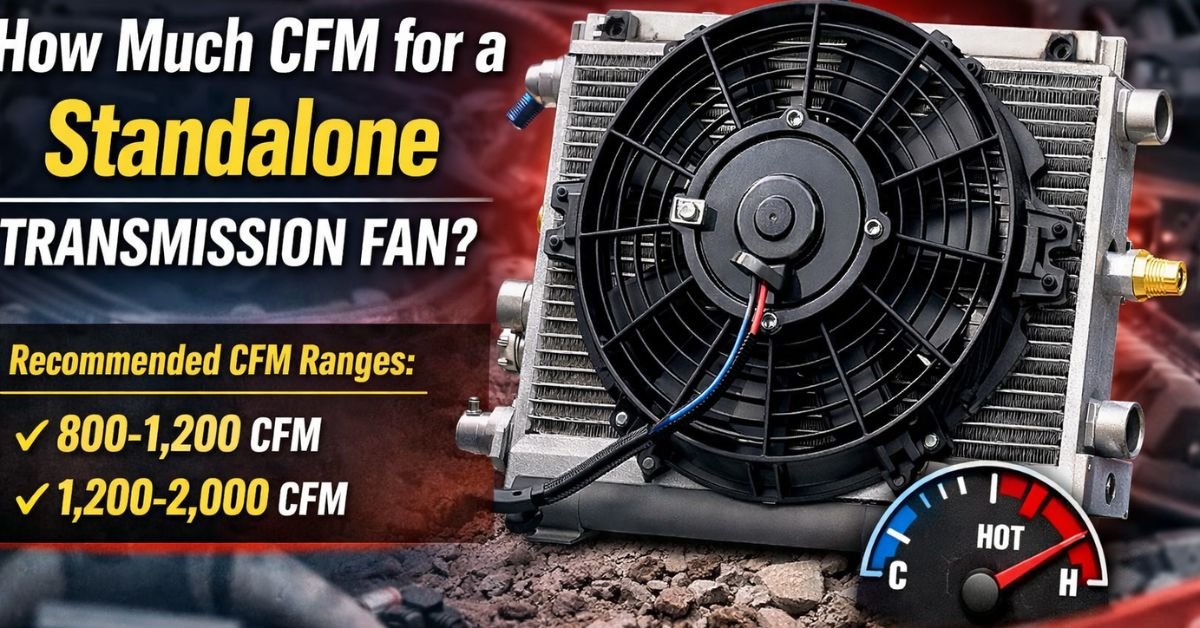
Recommended CFM: 800–1,200 CFM
For vehicles that tow small trailers, campers, or boats, higher airflow is needed. This range offers a good balance between cooling performance and electrical load, especially when paired with a stacked-plate transmission cooler.
3. Heavy Towing, Off-Road, or Performance Use
Recommended CFM: 1,200–2,000 CFM
If your vehicle frequently tows heavy loads, climbs steep terrain, or sees high-performance driving, you’ll want a higher-CFM fan. These fans provide aggressive airflow and are commonly used in diesel trucks, off-road rigs, and race applications.
Must Read: How Do You Read a Transmission Dipstick?
Factors That Affect How Much CFM You Need
Choosing the right fan isn’t just about the number on the box. Several factors influence how much airflow your transmission actually needs:
Cooler Size and Design
Larger coolers require more airflow. Stacked-plate coolers are more efficient but still benefit from higher CFM fans under load.
Vehicle Weight
Heavier vehicles generate more heat due to increased load on the transmission.
Towing and Payload
The more weight you pull, the more heat your transmission creates.
Climate
Hot climates demand higher airflow to compensate for elevated ambient temperatures.
Mounting Location
Fans mounted behind the grille may need less CFM than those placed in tight or enclosed spaces.
Is More CFM Always Better?
Not necessarily. While higher CFM improves cooling, it also increases:
- Electrical draw on the charging system
- Fan noise
- Installation complexity
For most street vehicles, anything above 1,500 CFM is unnecessary unless the vehicle is regularly under heavy stress.
Thermostats and Fan Control
For best results, pair your transmission fan with a thermostatic switch or temperature controller. This allows the fan to activate only when needed, reducing wear and electrical load while keeping fluid temperatures stable.
Final Thoughts
So, how much CFM do you need for a standalone transmission fan? For most applications, 800–1,200 CFM is the sweet spot. It provides reliable cooling for daily driving and moderate towing without unnecessary power consumption. Heavier-duty setups may benefit from 1,500+ CFM, while lighter vehicles can safely run less.
Choosing the correct CFM, combined with a quality transmission cooler and proper fan control, can dramatically extend the life of your transmission and prevent costly repairs. When it comes to transmission cooling, the right airflow makes all the difference.