
If you use bootmod3 (BM3) to monitor or tune your BMW, you may have noticed parameters related to camshaft angle, such as intake and exhaust camshaft angles. These values can look confusing at first, especially if you are trying to understand whether your engine is operating normally or if there is a problem with the variable valve timing system.
What Is Camshaft Angle in BM3? A Complete Guide for BMW Owners
Camshaft angle is an important engine parameter because it shows how the camshaft is positioned relative to a reference position. In modern BMW engines, the engine control unit continuously adjusts camshaft timing to improve power, fuel economy, emissions, and engine response. BM3 allows enthusiasts and tuners to monitor this information through live data and logs.
What Does Camshaft Angle Mean?
Camshaft angle refers to the angular position of a camshaft compared with a defined reference point. It is generally displayed in degrees and can change while the engine is running.
The camshaft regulates the opening and closing of the exhaust and intake valves.. By changing the camshaft position, the engine can alter valve timing according to engine speed, load, throttle position, temperature, and other operating conditions.
For example, during certain driving conditions, the engine may advance or retard the camshaft to improve low-speed torque. At higher RPM, different camshaft timing can help the engine breathe more efficiently and produce more power.
In a BMW equipped with variable valve timing, the camshaft angle is not necessarily fixed. The engine’s control system constantly makes adjustments.
What Is Camshaft Angle in BM3?
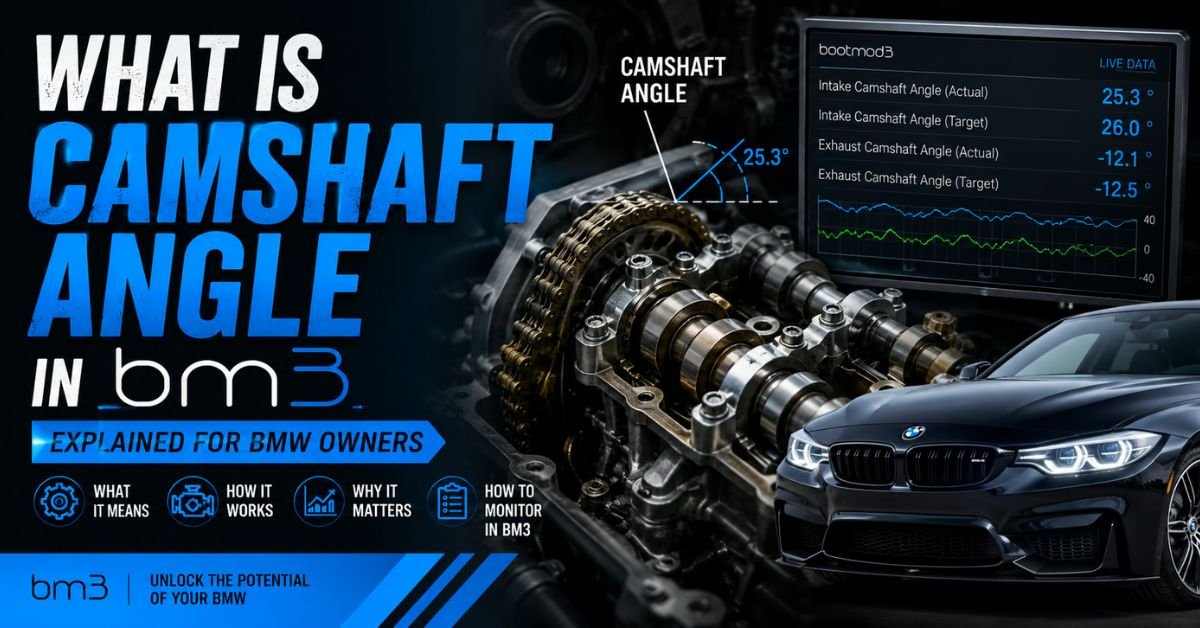
In BM3, camshaft angle is a data parameter that can be monitored through logging. Depending on the BMW engine and calibration, you may see different parameters for intake and exhaust camshafts and, in some cases, values representing commanded and actual camshaft positions.
The important distinction is between what the engine control system requests and what the camshaft actually achieves.
A commanded camshaft angle represents the position the engine computer wants the camshaft to reach. The actual camshaft angle represents the position being detected by the engine’s sensors.
When the system is working correctly, the actual position should generally follow the requested position within an acceptable range. The exact values can change depending on engine speed, load, temperature, throttle position, and the tune being used.
Why Is Camshaft Angle Important?
Camshaft timing has a direct effect on how an engine operates. Even a relatively small change in valve timing can influence torque, horsepower, fuel consumption, emissions, and drivability.
When camshaft timing is properly controlled, the engine can optimize valve operation for different conditions. At low RPM, the engine may use timing that improves torque and response. At higher RPM, the timing strategy may change to improve airflow and power.
This is one reason camshaft angle data can be useful when analyzing BMW engine logs through BM3.
Camshaft Angle and VANOS
BMW uses VANOS, a variable camshaft timing system, to adjust camshaft position while the engine is operating. Depending on the engine, VANOS can control the intake camshaft, exhaust camshaft, or both.
The engine computer uses information from multiple sensors to determine the appropriate camshaft position. It then controls the VANOS system to move the camshaft toward the desired position.
Because of this, camshaft angle data can provide useful information about how the VANOS system is responding.
If the requested and actual positions remain significantly different, it can sometimes indicate a mechanical, electrical, hydraulic, or control-related problem. However, a difference in values does not automatically mean a component has failed. The operating conditions and manufacturer-specific specifications must also be considered.
How to Check Camshaft Angle in BM3
Checking camshaft angle is generally done through the logging functionality available in BM3.
Before starting a log, make sure you select the relevant camshaft parameters available for your particular BMW engine. Depending on the engine and software version, the exact names of the parameters may differ.
A typical diagnostic process involves:
- Connect to your BMW using BM3.
- Open the relevant logging or monitoring section.
- Select the available intake and exhaust camshaft parameters.
- Include RPM, engine load, throttle position, and other useful engine parameters.
- Perform the desired driving test safely and legally.
- Review the recorded data after the run.
- Compare requested and actual camshaft behavior.
Looking at camshaft angle by itself may not provide enough information. It is much more useful when combined with RPM, load, boost, ignition timing, fuel trims, and other relevant parameters.
Must Read: How to Replace a 2013 BMW 328i Camshaft Position Sensor?
What If Camshaft Angle Is Not Matching?
If the actual camshaft angle does not closely follow the requested value, there are several possible explanations.
One possibility is a problem with the VANOS system. Other possibilities can include a faulty camshaft position sensor, oil-related issues, a VANOS solenoid problem, wiring problems, timing-chain issues, or mechanical problems inside the engine.
Engine oil is particularly important for many variable valve timing systems because hydraulic pressure is used to control camshaft adjustment. Incorrect oil level, unsuitable oil, contamination, or restricted oil passages can affect VANOS operation.
However, you should not diagnose a problem simply because you see a particular camshaft angle in a BM3 log. The correct interpretation depends on the specific BMW engine, operating conditions, calibration, and fault codes.
Does Tuning Affect Camshaft Angle?
Yes, engine calibration can influence camshaft timing strategies. Performance tunes can modify how the engine operates under different RPM and load conditions.
However, camshaft angle should not be judged simply by whether a number is higher or lower than another vehicle’s log. Different BMW engines, tunes, fuel types, temperatures, and operating conditions can produce different readings.
When comparing logs, it is best to compare similar conditions and, whenever possible, use reliable reference data for the exact engine and calibration.
Camshaft Angle vs. Camshaft Timing
Although these terms are closely related, they are not always interchangeable.
Camshaft angle generally describes the measured or commanded position of the camshaft in degrees.
Camshaft timing describes how that camshaft position affects the timing of valve events relative to crankshaft position and the engine’s operating cycle.
In simple terms, camshaft angle is a measurement of position, while camshaft timing is the broader concept of when the valves operate.
Final Thoughts
Camshaft angle in BM3 is an important parameter for BMW enthusiasts, tuners, and technicians who want to understand what is happening inside the engine’s variable valve timing system. It can help you monitor intake and exhaust camshaft behavior and compare requested positions with actual positions during different operating conditions.
However, there is no single camshaft angle value that should automatically be considered “normal” for every BMW. The correct value depends on the engine, RPM, load, temperature, VANOS strategy, and calibration.
If you are troubleshooting a BMW, use BM3 camshaft data together with fault codes and other relevant logging parameters rather than relying on one number alone. When interpreted correctly, camshaft angle data can be a valuable tool for understanding engine performance and identifying potential timing or VANOS-related issues.