
When it comes to automatic transmissions in Ford trucks and SUVs of the late 1990s and early 2000s, the E40D (also known as the E4OD) is one of those names that sparks both nostalgia and confusion among enthusiasts, mechanics, and anyone restoring older vehicles. In this post, we’ll explore what this transmission is, its history, and which 2001 Ford vehicles were equipped with it — or close to it — and why there’s often confusion around it.
🚗 What Ford Vehicles Used an E40D Transmission in 2001?
🔧 What Is the E40D / E4OD Transmission?
The E4OD is a four-speed automatic transmission developed by Ford and introduced in 1989. It was Ford’s first electronically controlled four-speed automatic designed for heavier trucks and SUVs and was based on the robust C6 transmission but with an added overdrive gear and electronic control system. (Wikipedia)
The abbreviation “E4OD” stands for:
- E – Electronic
- 4 – Four forward gears
- O – Overdrive
- D – Diesel (original naming)
Though colloquially referred to as E40D in some parts catalogs, swap guides, and enthusiast forums, it’s the same transmission family most people mean when they say “E4OD.” (TransDepot)
🛠 Ford’s Transmission Transition in the Late ’90s
By 1998–1999, Ford began phasing the E4OD out and replacing it with an improved successor called the 4R100. The 4R100 was basically a beefed-up and more durable iteration designed to handle higher torque, especially for diesel Power Stroke engines. (Go Powertrain)
Important note: Although the E4OD/E40D design carried forward into the 4R100 with many similarities, Ford generally considers models from the late ’90s onward to be 4R100 — not true E4OD — for official parts and service purposes. (Wikipedia)
🗓 So, What About 2001?
By the 2001 model year, the 4R100 had largely replaced the E4OD in Ford’s truck and SUV lineup. Official transmission lists and service guides show that 1999 through the early 2000s applications were almost all 4R100 — not E4OD. (Wikipedia)
That means if you’re working with a late-model Ford from 2001 and someone tells you it has an E40D, there’s a good chance you’re actually dealing with a 4R100, the updated successor. The physical housings and bolt patterns are similar, and many parts can interchange with splicing or identification, but Ford generally defines 2001 units as 4R100 — even if enthusiasts sometimes still call it an E4OD. (Go Powertrain)
Must Read: What Causes Transmission Problems?
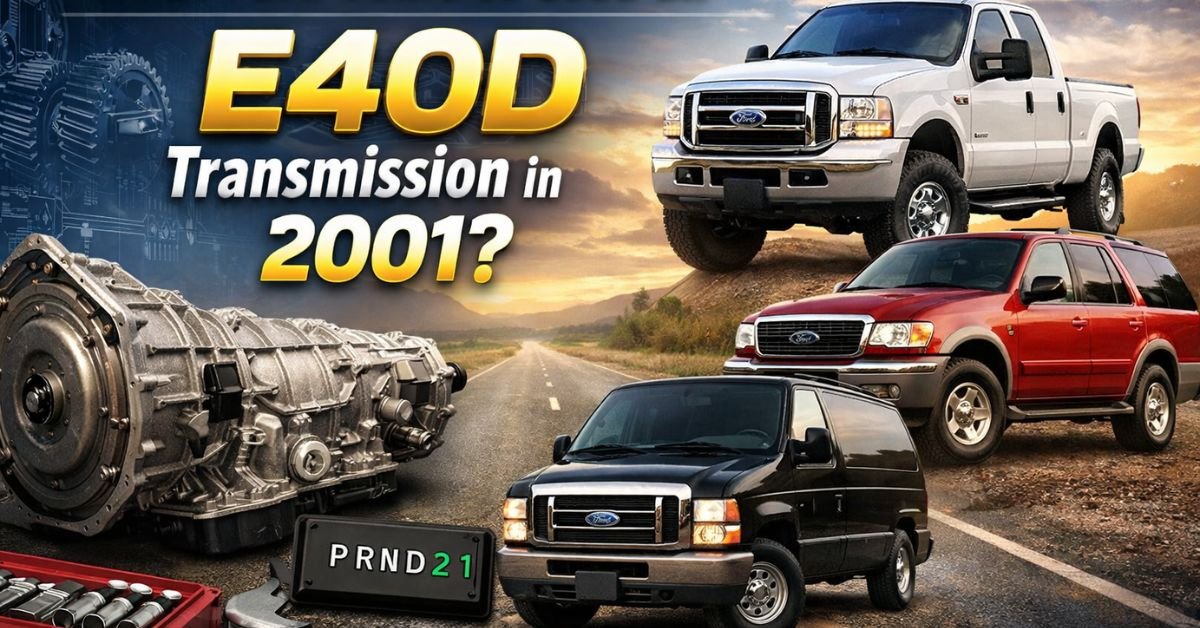
🚙 2001 Ford Models Often Mistaken for E4OD
Even though the E4OD was mostly phased out by 2001, the vehicles that would have used it in earlier model years and by extension have similar 4R100 transmissions in 2001 include:
🛻 Ford F-Series Trucks
- F-250 Super Duty (1999–2003) — Automatics in 2001 are 4R100. (Wikipedia)
- F-350 Super Duty (1999–2003) — Also typically equipped with 4R100 automatics. (Wikipedia)
- F-150 (some heavy-duty configurations) — Mainly 4R100 by this year. (Wikipedia)
These vehicles had a long history of using the E4OD in earlier years (late ’80s through mid-’90s), but by 2001 the factory automatics were 4R100 even though the designs are very related. (Blue Oval Trucks)
🚐 Ford E-Series (Econoline) Vans
- E-Series full-size vans that historically used E4OD in the ’90s often carried over the newer 4R100 where an automatic was factory-installed by 2001. (Wikipedia)
🚙 Ford Excursion & Expedition
- Larger SUVs like the Excursion and Expedition in the early 2000s also used the 4R100 rather than the original E4OD. (Blue Oval Trucks)
🧠 Why the Confusion?
There are a few reasons the E4OD name gets applied to 2001 vehicles:
- Parts Catalog Overlaps: Some service and parts references list E40D as an internal or archival code from older documentation. (Motorcraft)
- Enthusiast Terminology: Many truck forums and rebuilders still call the 4R100 “E4OD” because they share common ancestry and similar external dimensions. (Ford-Trucks.com)
- Visual Similarities: Most visual inspections look nearly identical, making it easy to assume older naming applies. (TransDepot)
🏁 Summary
- The E4OD (E40D) transmission was Ford’s electronically controlled 4-speed automatic used extensively through the late ’80s and early to mid-’90s. (Wikipedia)
- By 2001, Ford had mostly transitioned these applications to the 4R100, an evolution of the E4OD designed for greater durability and higher torque handling. (Go Powertrain)
- If you see references to E40D in 2001 vehicles, it’s usually referring to a closely related 4R100 unit — not the original E4OD as fitted in earlier model years. (Wikipedia)
- Vehicles like F-250, F-350, E-Series vans, and large SUVs in 2001 used the 4R100 and often get grouped under the E4OD family colloquially. (Wikipedia)