
When most drivers think about what makes their vehicle move, they usually picture the engine. But right behind the engine sits one of the most complex and advanced mechanical systems in the entire vehicle: the automatic transmission. This component is responsible for shifting gears, transferring power, and ensuring your car accelerates smoothly. Because of its intricate design, many car owners wonder: how many moving parts are in an automatic transmission?
The short answer: hundreds. But to truly understand why, it helps to look inside and break down what makes an automatic transmission such a sophisticated piece of engineering.
How Many Moving Parts Are in an Automatic Transmission?
Why Automatic Transmissions Are So Complex
An automatic transmission’s job is more advanced than it might seem. Unlike a manual transmission, which simply uses gear pairs and a clutch, an automatic system must:
- Automatically select gears
- Regulate power output
- Maintain the correct gear ratios
- Handle various driving loads
- Operate smoothly without driver input
To accomplish all this, an automatic transmission relies on multiple systems working together, each containing numerous moving parts. These systems include the torque converter, planetary gearsets, hydraulic system, clutches, bands, pumps, and solenoids. When combined, these parts easily number in the hundreds.
Breaking Down the Moving Parts
Let’s look at the key assemblies and how many moving parts each contributes.
1. Torque Converter
This is the automatic transmission’s version of a clutch. It uses fluid dynamics instead of physical plates to transfer power.
A torque converter alone has about 20–30 moving components, including:
- Turbine
- Impeller
- Stator
- Lock-up clutch
- Needle bearings
Though it seems simple from the outside, it is incredibly busy internally.
2. Planetary Gearsets
This is where most of the movement happens. Automatic transmissions use multiple planetary gearsets — usually two to four assemblies.
Each gearset contains:
- 1 sun gear
- 1 ring gear
- 3–6 planet gears
- A planet carrier
- Bearings
Each set typically has 15–25 moving parts, and since several gearsets are used together, the total quickly adds up to 50–80 moving parts or more.
3. Clutches and Bands
Automatic transmissions use friction clutches, multi-plate clutch packs, and bands to lock or release specific gears.
A typical transmission contains:
- 5–8 clutch packs
- Each clutch pack with 5–10 plates
- Servo mechanisms
- Springs and pistons
Altogether, this assembly contains 50–100 moving parts, depending on design.
4. Hydraulic System
The hydraulic system controls gear engagement through fluid pressure. It includes:
- Valves
- Solenoids
- Pistons
- Valve body channels
The valve body alone — often called the brain of the transmission — contains dozens of small moving valves, springs, and passages. Altogether, the valve body and hydraulic controls usually add 30–50 moving components.
5. Pumps and Shafts
To keep everything lubricated and pressurized, the transmission relies on:
- Oil pumps
- Input shaft
- Output shaft
- Bushings
- Bearings
This part of the system adds another 20–30 moving parts.
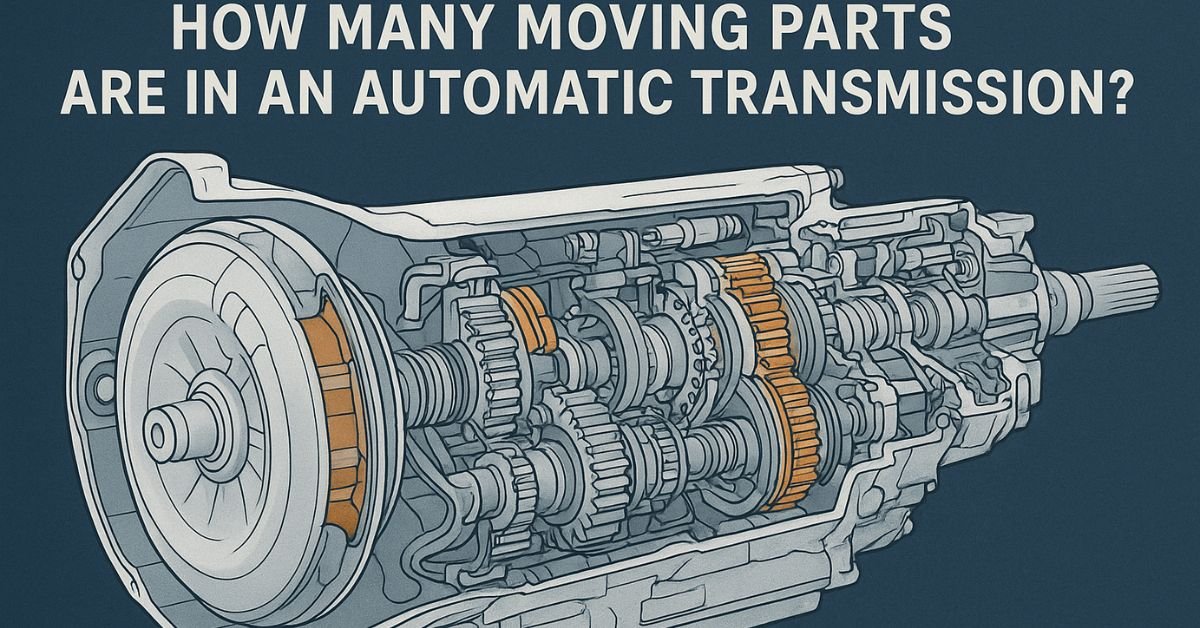
Final Count: How Many Moving Parts Are There Really?
If you sum all the assemblies, the total number of moving parts in a modern automatic transmission is typically:
More than 200 moving parts
Some advanced transmissions — such as dual-clutch automatics or continuously variable transmissions — can contain 300 or more moving pieces.
This complexity is exactly why automatic transmissions are:
- Expensive to repair
- Sensitive to dirty or low fluid
- Highly dependent on proper maintenance
- Remarkably smooth when functioning correctly
Why Knowing This Matters
Understanding how many moving parts your automatic transmission contains helps you appreciate:
1. The importance of fluid changes
With so many delicate components, clean fluid is essential.
2. Why transmission repairs cost so much
Labor time, complexity, and precision all contribute to higher repair bills.
3. The need for professional diagnostics
Because so many components depend on each other, guessing is never effective.
4. How impressive modern engineering really is
Transmissions are masterpieces of mechanical design.
Conclusion
So, how many moving parts are in an automatic transmission? While the exact number varies by design and manufacturer, most modern automatics contain well over 200 moving parts. These pieces work together seamlessly to provide smooth shifting, power delivery, and efficient driving. Keeping the transmission maintained with proper fluid levels and routine service is the best way to ensure these hundreds of components continue functioning flawlessly for years to come.