
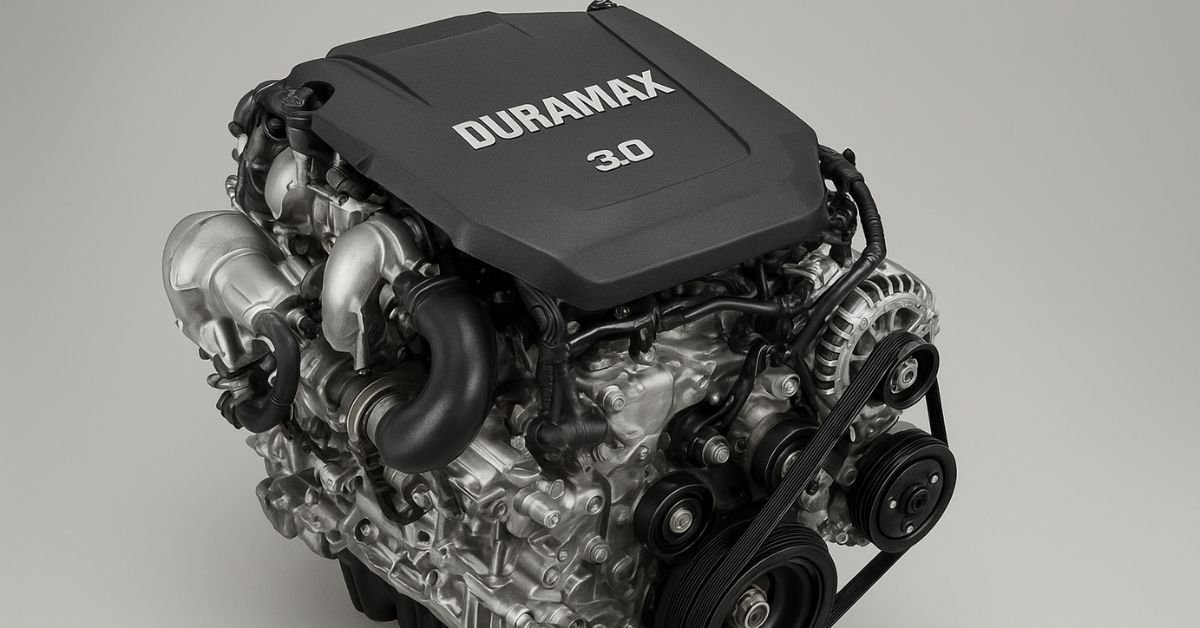
If you’re wondering whether the 3.0 L Duramax diesel engine is worth your time and investment, you’re asking the right question. This engine—used in the Chevrolet Silverado 1500, GMC Sierra 1500, and various full-size SUVs—has plenty of strengths, but also some notable caveats. Below, I’ll walk through what makes it good, what issues users report, and whether it might be the right choice for you.
Is the 3.0 L Duramax a Good Engine?
👍 What’s Good About It
Strong performance and modern design
The 3.0 L Duramax delivers solid numbers: in its initial form (RPO code LM2), it put out ~277 hp and 460 lb-ft of torque, with peak torque available as low as ~1,250 rpm. (MotorTrend) That low-rpm torque is excellent for towing and general driving when you want effortlessness.
It also boasts modern diesel engineering: a common-rail injection system (up to ~2,500 bar pressure) with many injection events per cycle for cleaner combustion and smoother idle. (Daily Car Tips)
Further, the engine’s construction—aluminum block/head, forged steel crank, iron liners, etc.—shows GM aimed for both efficiency and durability. (MotorTrend)
Fuel economy and usability
For those mindful of fuel costs or doing lots of highway driving, this engine performs well. The published EPA numbers show for 2WD variants: 33 mpg highway / 23 city / 27 combined. (MotorTrend) Real-world owners often report even better under the right driving conditions. For example:
“I’m super impressed with the fuel economy … I’m hitting over 30 mpg at times.” (Reddit)
So if your driving is mostly highway and you use the truck as a commuter or for regular towing, the 3.0 L Duramax offers an especially attractive fuel-vs-power balance.
Towing capability
Though it’s a smaller diesel (compared to some big 6.6-L diesels), it still has solid towing credentials. The earlier versions of the engine provided ~9,300 lb max tow, and with updated packaging (for 2023+), the number rises to ~13,300 lb in certain configurations. (SlashGear) For many buyers of half-tons or full-size SUVs, that is more than enough.
Refinement
Diesel engines used to be loud, vibration-prone beasts. Many owners of the 3.0 L Duramax comment that it is much smoother and quieter than older diesels. From one enthusiast:
“We love ours … highway trips … runs like it would new.” (Reddit)
This helps the engine appeal to people who want diesel benefits but don’t want the typical “diesel truck noise” trade-off.
👎 What Are the Weaknesses / What to Watch Out For
Known reliability quirks
While many owners are pleased, there are recurring reports of certain issues. Some of the more documented problems:
- Long cranking times or no-start condition. One of the root causes identified: a faulty camshaft position exciter/trigger wheel that may contact the timing chain and cause timing issues. (SlashGear)
- Oil leaks—especially via the rear main seal. These can sometimes be serious. (SlashGear)
- Diesel exhaust fluid (DEF) system or emissions-system faults: sensors, hoses, etc. (Jalopnik)
- Some turbocharger / EGR / oil-consumption issues. For example:
“Injector failure … blocked injector or not receiving enough fuel … turbocharger failure …” (MotorAudit)
Maintenance requirements & cost of ownership
Because this is a modern, sophisticated diesel with emissions equipment, its maintenance demands can be higher than a simple gasoline engine. For example:
- Diesel fuel quality, DEF usage, periodic filter changes, proper oil schedule—all matter.
- Some sources estimate higher annual maintenance cost for this engine compared to generic gas engines. (MyEngineSpecs.com)
- Some critical components are in harder-to-service locations. For example, the timing chain system is at the rear of the engine (between engine & transmission) which complicates major work. (Daily Car Tips)
Depends on driving style
If your driving is mostly short trips, low load, idling etc., you might not fully benefit from the diesel’s advantages and you might run into more frequent regeneration cycles of emissions equipment. One owner writes:
“My daily work commute is around 6 miles… based on your experience, would that be enough to get the engine warm enough to avoid the frequent regens?” (Reddit)
Thus, unless you regularly drive it far enough/have steady load, you may encounter some of the drawbacks of using a diesel for mostly short urban use.
✅ My Verdict: Is It a Good Engine?
Putting it all together: yes — the 3.0 L Duramax is a good engine, and in many cases a very good engine. But like all engines, “good” depends on match to use-case, maintenance discipline, and expectation.
When it makes sense:
- If you buy a truck/SUV equipped with this engine and you’re going to do consistent highway driving, towing, hauling, or will put sustained miles on it.
- If you appreciate the fuel economy benefit and are comfortable with diesel fuel + emissions system + occasional higher-cost parts.
- If you choose a newer version (2023+ refresh) where some issues may have been addressed.
When you might look elsewhere or proceed with caution:
- If your driving is < 10-15 miles per day, mostly low load, stop-and-go city driving — you may not see the benefit and you might face more emission-system upkeep.
- If you are planning major modifications / high performance tuning: aftermarket support is there but not as mature as for some older big-diesels.
- If you are buying used and the maintenance history is unclear — be sure to check for prior issues (e.g., oil leaks, DEF/emissions repairs, long-cranking history).
🔍 Buyer Tips / What to Check
Here are some practical checks if you’re looking at a vehicle with this engine:
- Ask for service history: regular oil changes, proper diesel-spec oil, filters changed, how often short trips vs long trips, any emissions codes.
- On test drive, note how the engine starts (does it crank normally?), check for oil spots under the engine (possible oil-leak indicators).
- If possible review forum reports or owner-groups for the specific year and version (LM2 vs later refresh). Some issues may be more prevalent in early years.
- Confirm that the towing/usage has been appropriate (diesels like to be used). A vehicle used for many short idle trips only may have more wear.
- Find out about any warranty or recall/TSB coverage: some of the documented issues are subject to technical service bulletins.
- Maintenance budget: consider diesel fuel cost, DEF fluid cost, filter / service intervals. Make sure you factor these in.
🧾 Summary
If I were given a short summary for you:
The 3.0 L Duramax is a modern, efficient, strong diesel engine with good torque, good fuel economy, and strong real-world reports — provided it’s used in the right way and well maintained. However, it’s not bullet-proof, and you’ll want to check for certain known issues and be comfortable with the maintenance demands of a modern diesel.