
Knowing what type of transmission your vehicle has is more than just a piece of trivia—it’s essential information for maintenance, repairs, and even resale value. Transmissions are the unsung heroes of your car, responsible for transferring power from the engine to the wheels, enabling smooth acceleration and efficient fuel consumption. But how can you tell whether your vehicle has a manual, automatic, CVT, or dual-clutch transmission? In this guide, we’ll break down the steps and tips to identify your transmission accurately.
How Do I Tell What Transmission I Have?
Understanding the Basics of Vehicle Transmissions
Before diving into how to identify your transmission, it’s important to understand the common types:
- Manual Transmission (MT): Requires the driver to manually change gears using a clutch pedal and gear stick. Manual transmissions are less common in modern vehicles, especially in the U.S., but they are prized for control and simplicity.
- Automatic Transmission (AT): Changes gears automatically without driver intervention. Most vehicles on the road today are automatic, offering convenience and ease of use.
- Continuously Variable Transmission (CVT): Uses a system of pulleys and belts instead of fixed gears, providing smooth acceleration and optimized fuel efficiency.
- Dual-Clutch Transmission (DCT): Essentially a high-performance automatic with two clutches, offering rapid gear shifts and often found in sports cars.
Understanding these categories will make it easier to identify your transmission type.
Step 1: Check Your Vehicle’s Owner Manual
The easiest and most reliable way to identify your transmission is by consulting your owner’s manual. Most manuals will clearly state the type of transmission installed in the vehicle, along with the recommended maintenance schedule. Look under sections such as “Specifications,” “Technical Data,” or “Vehicle Overview.” This document is tailored specifically to your car and eliminates any guesswork.
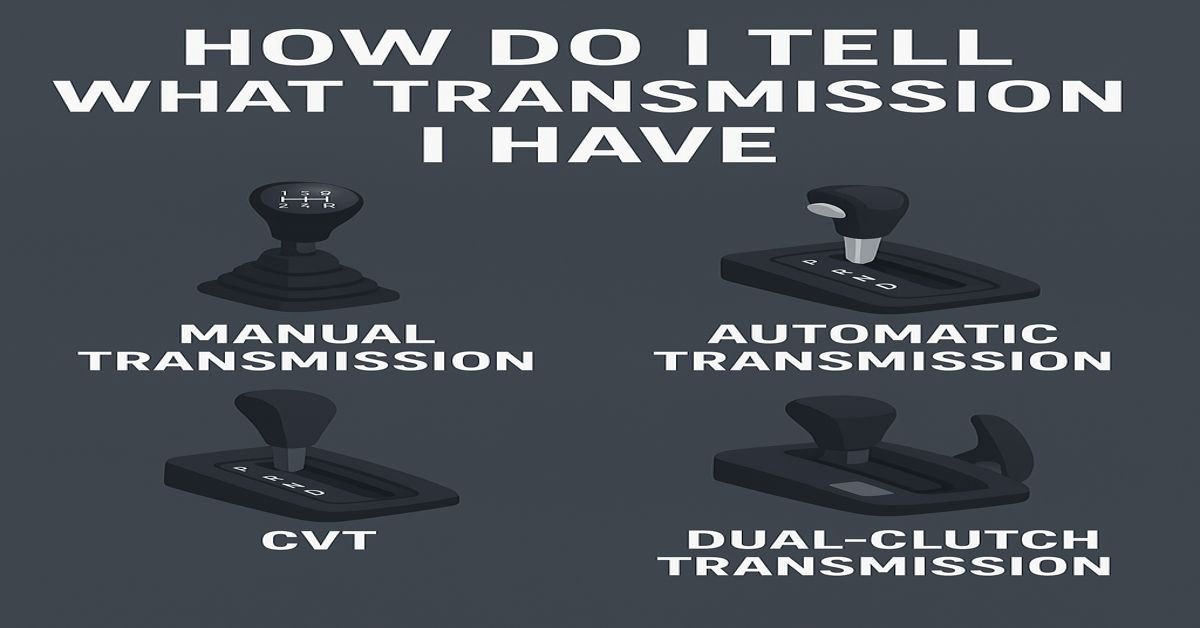
Step 2: Examine the Gear Shifter
A quick visual check can give you a strong hint:
- Manual Transmission: Look for a clutch pedal to the left of the brake. The gear shifter will have a pattern (usually 5 or 6 speeds) marked on top.
- Automatic Transmission: No clutch pedal is present. The gear shifter will typically have positions like P (Park), R (Reverse), N (Neutral), and D (Drive).
- CVT: Often looks like a standard automatic but may lack distinct “gear positions” beyond Park, Reverse, Neutral, and Drive.
- Dual-Clutch Transmission: Gear shifter may look like a traditional automatic, but paddle shifters behind the steering wheel may indicate a DCT.
Visual cues are helpful but not always definitive, especially with CVTs and DCTs, which mimic standard automatics.
Step 3: Check the Vehicle Identification Number (VIN)
Every vehicle has a unique VIN, typically located on the dashboard near the windshield or on the driver’s side door jamb. By decoding your VIN—either using online VIN decoders or through your dealership—you can find detailed specifications, including the transmission type. This method is especially useful if your car has optional transmission packages that might not be obvious from a visual inspection.
Step 4: Look for Transmission Labels or Stamps
Some manufacturers label the transmission either on the housing or inside the engine bay. You may find a plate or sticker with the model number and type. While this method requires a bit more effort and knowledge about what the codes mean, it can provide a precise identification.
Step 5: Consult a Mechanic or Dealership
If you are still unsure, a professional mechanic or your dealership can quickly confirm the transmission type. They can also provide additional insights, such as whether your transmission is a standard automatic or a newer type like a CVT or dual-clutch system. This is often the safest route for those unfamiliar with automotive details.
Step 6: Observe Driving Behavior
Sometimes, how your car drives can give clues:
- If you feel a distinct clutch pedal and must shift gears yourself, it’s a manual.
- If the car shifts smoothly without any input, it’s likely an automatic.
- CVTs often have a “rubber band” feeling during acceleration because there are no fixed gear steps.
- Dual-clutch systems offer very fast, precise gear shifts and may be noticeable during sporty driving.
Why Knowing Your Transmission Matters
Understanding your transmission type is crucial for:
- Maintenance: Each transmission type has unique service intervals and fluid requirements. Using the wrong fluid or ignoring service schedules can lead to expensive repairs.
- Repairs: When replacing or repairing a transmission, knowing the type ensures the correct parts are used.
- Resale: Buyers often want to know transmission type as it affects driving experience and fuel economy.
Conclusion
Identifying your vehicle’s transmission doesn’t have to be complicated. Start with the owner’s manual, examine the gear shifter, decode your VIN, and if needed, consult a professional. Whether you have a manual, automatic, CVT, or dual-clutch transmission, knowing exactly what you’re dealing with ensures better maintenance, improved performance, and a smoother driving experience. Take the time today to identify your transmission—you’ll thank yourself the next time your car needs service or you’re considering an upgrade.