
A car battery is one of the most important components in any vehicle. It provides the electrical power needed to start the engine and run various electronic systems such as lights, radio, sensors, and onboard computers. While most people are familiar with battery voltage (volts) and capacity (amp-hours), fewer people understand the concept of watt-hours (Wh). Knowing how many watt-hours a car battery contains helps you better understand how much energy it stores and how long it can power electrical devices.
In this article, we will explain what watt-hours mean, how to calculate them for a car battery, and what the typical watt-hour capacity of common car batteries is.
How Many Watt-Hours Is a Car Battery?
What Is a Watt-Hour?
A watt-hour (Wh) is a unit of energy that tells you how much electricity a battery can store or deliver over time. In simple terms, it measures the total amount of electrical energy available in the battery.
For example, a battery rated at 600 watt-hours can theoretically supply 600 watts of power for one hour, or 60 watts for 10 hours.
To calculate watt-hours, you multiply the battery’s voltage (V) by its capacity in amp-hours (Ah).
Wh = V \times Ah
Where:
- Wh = Watt-hours
- V = Voltage
- Ah = Amp-hours
This formula helps convert the battery’s capacity into a measure of stored energy.
Typical Voltage and Capacity of a Car Battery
A 12-volt lead-acid battery is used in the majority of common passenger cars. The capacity of these batteries usually ranges between 40 Ah and 100 Ah, depending on the vehicle size and power requirements.
Here are some common examples:
| Battery Capacity | Voltage | Watt-Hours |
|---|---|---|
| 45 Ah | 12 V | 540 Wh |
| 60 Ah | 12 V | 720 Wh |
| 70 Ah | 12 V | 840 Wh |
| 80 Ah | 12 V | 960 Wh |
| 100 Ah | 12 V | 1200 Wh |
So, the average car battery stores roughly 600–1000 watt-hours of energy.
This means your car battery can theoretically power a 100-watt device for about 6–10 hours, although in real situations it will be less because of efficiency losses and the need to keep enough power to start the engine.
Example Calculation
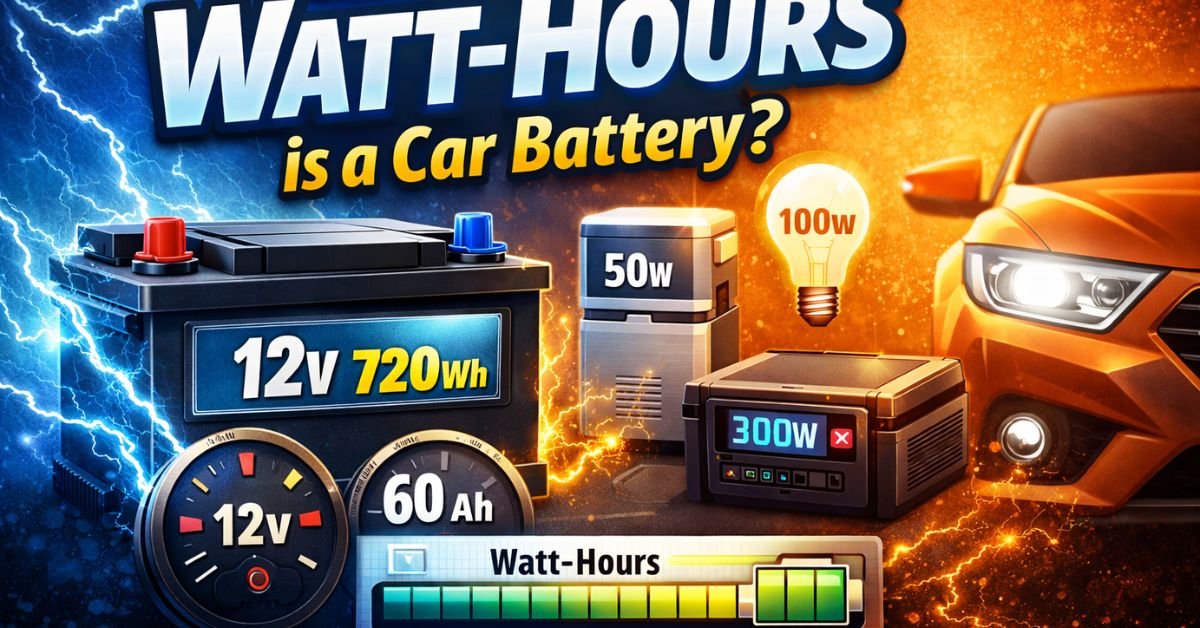
Let’s say your car battery is rated at 12 volts and 60 amp-hours.
Using the formula:
- Voltage = 12 V
- Capacity = 60 Ah
Multiply them:
12 × 60 = 720 watt-hours
This means the battery stores approximately 720 Wh of electrical energy.
However, it is not recommended to drain a car battery completely. Lead-acid batteries usually perform best when only 50% of their capacity is used to prevent damage.
So the usable energy might actually be around 360 Wh.
Why Watt-Hours Matter
Understanding watt-hours helps you estimate how long your battery can run different electrical devices. For example, if you want to run accessories from your car battery while the engine is off, knowing the energy capacity helps avoid draining the battery too much.
For instance:
- A 10-watt LED light could run for many hours.
- A 50-watt car refrigerator may run for several hours.
- A 300-watt inverter device would drain the battery much faster.
Because of this, watt-hours are especially useful for people who use their car battery for camping equipment, power inverters, emergency power, or off-grid setups.
Must Read: How Long Will a Car Battery Last Without an Alternator?
Difference Between Amp-Hours and Watt-Hours
Many batteries are labeled in amp-hours (Ah) rather than watt-hours. Amp-hours measure the amount of electric charge, while watt-hours measure actual energy.
For example:
- Two batteries may both have 60 Ah, but if one is 12 V and another is 24 V, the 24-volt battery stores twice the energy.
That’s why watt-hours give a clearer picture of how much usable power the battery contains.
How Much Power an Automobile Battery Can Provide
Even though a typical car battery may contain around 700–900 Wh, not all of that energy is usable. Several factors affect how long it can supply power, including:
- Battery age
- Temperature
- Efficiency of connected devices
- Engine starting requirements
Also, car batteries are designed mainly for short bursts of high current to start the engine, not for deep energy discharge like deep-cycle batteries.
If you frequently use your battery to power devices, a deep-cycle battery or portable power station may be a better choice.
Final Thoughts
A typical car battery stores between 500 and 1200 watt-hours of energy, depending on its voltage and amp-hour rating. The most common 12-volt car batteries with capacities around 60–70 Ah usually provide 700–850 Wh of stored electrical energy.
By using the simple formula of voltage multiplied by amp-hours, you can easily estimate the watt-hour capacity of any battery. Understanding this measurement helps you better manage your vehicle’s power usage and avoid draining the battery unexpectedly.
In short, while your car battery might look small, it actually holds a significant amount of energy—enough to start your engine and power multiple electrical systems every day.