
Modern vehicles rely on dozens of sensors to keep the engine running efficiently, and one of the most important is the crankshaft position (CKP) sensor. If you’ve recently replaced this sensor or performed engine-related repairs, you may have heard the term “crankshaft position sensor adaptation” or “crankshaft position relearn.” But what does it actually mean, and why is it necessary?
What Is Adaptation for a Crankshaft Position Sensor?
In this article, we’ll explain what crankshaft position sensor adaptation is, why it’s important, when it’s required, and how the process is typically performed.
What Is a Crankshaft Position Sensor?
An electronic gadget called a crankshaft position sensor keeps track of the crankshaft’s position and rotating speed. It sends this information to the engine control unit (ECU), allowing it to determine the correct timing for fuel injection and ignition.
Without accurate crankshaft position data, the engine may experience:
- Hard starting
- Engine misfires
- Rough idling
- Poor acceleration
- Increased fuel consumption
- Engine stalling
- Illuminated Check Engine Light
Because the ECU depends on this sensor for precise engine timing, any disruption can significantly affect performance.
What Does Adaptation Mean for a Crankshaft Position Sensor?
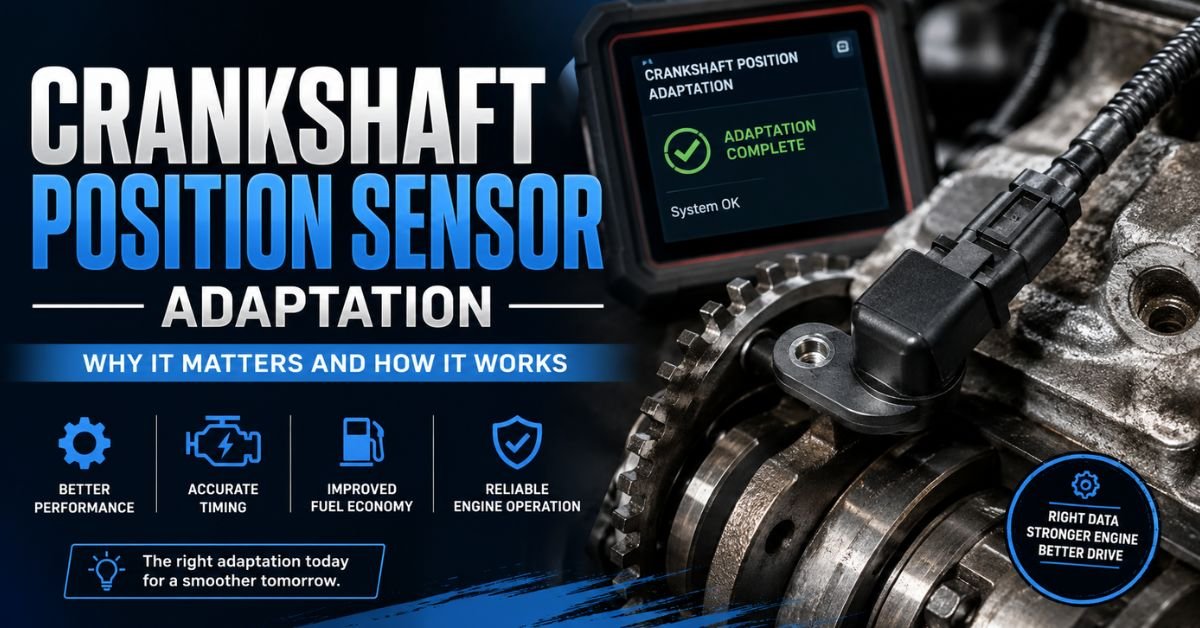
Crankshaft position sensor adaptation, often called a crankshaft variation relearn or CKP relearn, is the process of teaching the ECU the exact relationship between the crankshaft sensor signal and the crankshaft’s actual position.
Over time, the ECU stores reference values based on the engine’s normal operation. When a new crankshaft position sensor is installed—or certain engine components are replaced—those stored values may no longer match the new sensor readings.
The adaptation process allows the ECU to update its stored calibration so it can accurately detect crankshaft position and engine speed.
Why Is Crankshaft Position Sensor Adaptation Necessary?
Not every vehicle requires a relearn procedure after replacing the crankshaft position sensor, but many modern vehicles do.
Adaptation may be necessary after:
- Replacing the crankshaft position sensor
- Replacing the engine control module (ECM/ECU)
- Installing a new crankshaft
- Replacing the timing chain or timing belt
- Replacing the harmonic balancer
- Performing major engine repairs
- Clearing ECU memory on some vehicles
Without completing the relearn process, the ECU may struggle to accurately identify crankshaft position variations, which can result in drivability issues.
Symptoms That Indicate Adaptation Is Needed
If your vehicle requires a crankshaft position sensor adaptation but it hasn’t been completed, you may notice:
- Check Engine Light remains on
- Diagnostic trouble codes related to crankshaft position
- Rough idle
- Random engine misfires
- Reduced engine performance
- Difficulty starting the engine
- Poor fuel economy
- Inconsistent ignition timing
These symptoms don’t always mean the sensor is defective—they may simply indicate that the ECU hasn’t been recalibrated.
How Is Crankshaft Position Sensor Adaptation Performed?
The exact procedure depends on the vehicle manufacturer and engine management system.
1. Scan Tool Relearn
Many manufacturers require a professional diagnostic scan tool.
The technician will:
- Connect the scan tool to the OBD-II port.
- Clear any stored fault codes.
- Select the crankshaft position relearn function.
- Follow the on-screen instructions.
- Start the engine and perform a controlled acceleration if required.
This is the most common and accurate method.
2. Automatic Self-Learning
Some vehicles automatically adapt after several drive cycles.
The ECU gradually learns the crankshaft position by monitoring engine operation under various driving conditions.
This may take several trips before adaptation is fully completed.
3. Manufacturer-Specific Procedure
Certain vehicles require a specific sequence, such as:
- Warm the engine to operating temperature.
- Place the transmission in Park or Neutral.
- Hold the brake pedal.
- Increase engine RPM to a specified level.
- Allow the ECU to complete the relearn.
Because procedures vary, it’s always best to consult the vehicle’s service manual.
Can You Drive Without Performing the Adaptation?
In some vehicles, yes. The engine may start and run normally even without a relearn.
However, if the ECU requires adaptation, driving without completing it can lead to:
- Reduced engine performance
- Misfire detection problems
- Check Engine Light illumination
- Incorrect ignition timing
- Failed emissions testing
For the best performance and reliability, completing the adaptation whenever required is recommended.
Must Read: How to Check a Crankshaft Position Sensor?
Does Every Vehicle Need a CKP Relearn?
No.
Whether a relearn is necessary depends on the manufacturer and model.
Many older vehicles simply recognize the new sensor automatically.
Newer vehicles with advanced engine management systems are much more likely to require crankshaft position sensor adaptation after repairs.
Examples include certain models from:
- Chevrolet
- GMC
- Cadillac
- Chrysler
- Dodge
- Jeep
- Ford
- Nissan
- Toyota
- Honda
Always verify the requirements for your specific vehicle.
Can You Perform the Adaptation Yourself?
If your vehicle supports automatic learning, you may not need any special tools.
However, if a scan-tool relearn is required, you’ll typically need:
- A relearn-capable professional OBD-II diagnostic scanner
- Access to the manufacturer’s service procedure
Basic code readers usually cannot perform crankshaft variation relearns.
If you’re unsure, a qualified repair shop can complete the procedure in a short amount of time.
Tips After Replacing a Crankshaft Position Sensor
To ensure proper operation:
- Install a high-quality replacement sensor.
- Inspect the sensor wiring and connectors.
- Verify proper sensor gap if adjustable.
- Clear stored diagnostic trouble codes.
- Complete the required adaptation or relearn.
- Test drive the vehicle to confirm normal operation.
Following these steps helps prevent recurring engine performance issues.
Frequently Asked Questions
Is crankshaft position sensor adaptation the same as a relearn?
Yes. The terms adaptation, relearn, and crankshaft variation relearn are often used interchangeably. They all refer to recalibrating the ECU to recognize the crankshaft sensor’s signal accurately.
Can a bad crankshaft position sensor cause adaptation to fail?
Yes. If the sensor is faulty, improperly installed, or has damaged wiring, the ECU may not complete the relearn process successfully.
How long does crankshaft position sensor adaptation take?
A scan-tool relearn usually takes 5–15 minutes, while automatic adaptation may require several normal driving cycles.
Will disconnecting the battery reset the adaptation?
On some vehicles, disconnecting the battery can erase learned values, while others retain the data. The behavior varies by manufacturer.
Conclusion
Crankshaft position sensor adaptation is an important calibration process that allows the engine control unit to accurately interpret signals from the crankshaft position sensor. While not every vehicle requires a relearn after sensor replacement, many modern vehicles do. Completing the adaptation ensures proper ignition timing, reliable engine performance, accurate misfire detection, and optimal fuel efficiency.
If you’ve recently replaced your crankshaft position sensor or completed major engine repairs, checking whether your vehicle requires a crankshaft position relearn can save you from persistent warning lights and drivability problems. When in doubt, consult your vehicle’s service manual or a qualified technician to ensure the adaptation is performed correctly.