
If you are interested in BMW tuning, you may have come across the term camshaft angle in Bootmod3 (BM3). For many BMW owners, especially those who are new to ECU tuning, camshaft angle data can look confusing at first. However, understanding what it means can help you better understand engine timing, performance, and potential problems with the variable valve timing system.
What Is Camshaft Angle in Bootmod3? A Complete Guide
Bootmod3 is a popular BMW engine tuning and monitoring platform that allows users to flash custom or OTS (off-the-shelf) maps, monitor engine parameters, and analyze vehicle data. Among the parameters that can be monitored are camshaft-related values, which can provide useful information about how the engine’s valve timing is operating.
What Is Camshaft Angle?
Camshaft angle refers to the position of the camshaft relative to a reference position, usually associated with the crankshaft and the engine’s valve timing. The camshaft regulates the opening and closing of the exhaust and intake valves. Changing its position changes the timing of these valve events.
Modern BMW engines use variable valve timing, which allows the engine computer to adjust camshaft position depending on operating conditions. This helps the engine balance power, fuel economy, emissions, idle quality, and drivability.
In simple terms, the camshaft angle tells you where the camshaft is positioned at a particular moment compared with its reference position.
What Does Camshaft Angle Mean in Bootmod3?
When you monitor your BMW through Bootmod3, camshaft angle is one of the parameters that can help you understand the operation of the engine’s variable valve timing system.
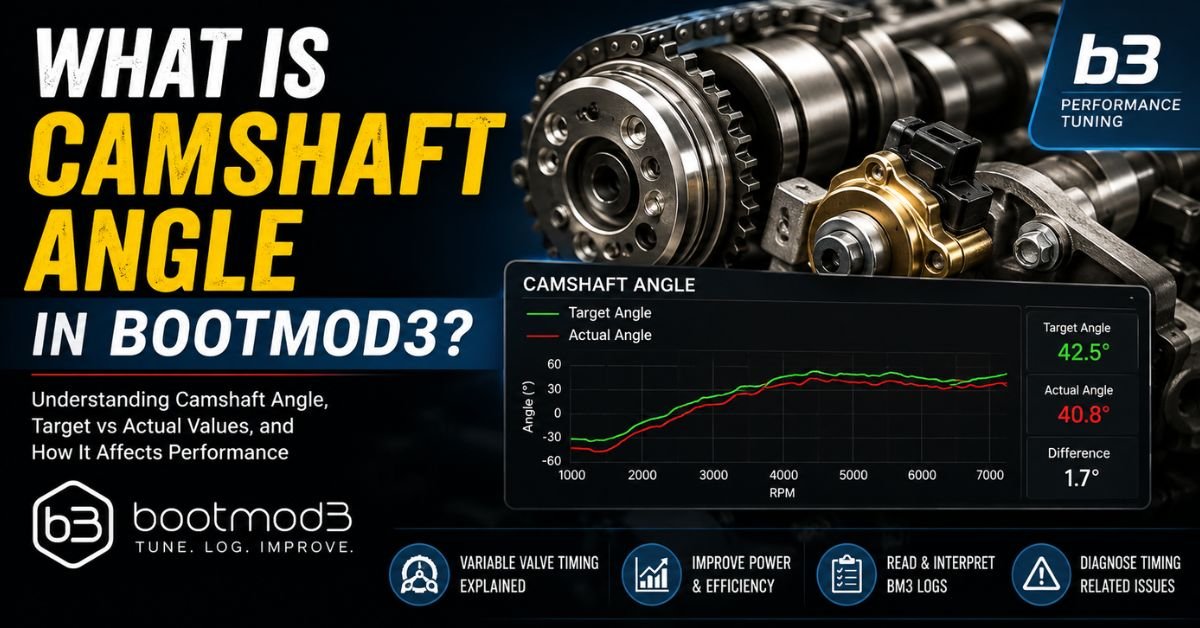
Depending on the BMW engine and the specific data channel being monitored, you may see values related to target camshaft angle and actual camshaft angle. The target represents where the engine control unit wants the camshaft to be, while the actual value represents where the camshaft is currently positioned.
The ECU constantly compares these values and controls the variable camshaft timing system to move the camshaft toward the desired position.
For example, if the ECU requests a particular camshaft angle, the variable valve timing system adjusts the camshaft until the actual position gets close to the requested position.
Why Is Camshaft Angle Important?
Camshaft position has a major effect on how an engine breathes. The valves need to open and close at the correct times for the engine to efficiently draw in air, burn the mixture, and remove exhaust gases.
Changing camshaft timing can influence:
- Low-speed torque
- High-RPM power
- Throttle response
- Fuel efficiency
- Idle quality
- Turbocharger response
- Exhaust emissions
This is particularly important on turbocharged BMW engines because valve timing can be adjusted according to engine speed, load, boost, and other operating conditions.
Target vs. Actual Camshaft Angle
One of the most useful things to understand when reading BM3 logs is the difference between target and actual camshaft angle.
The target angle is the position requested by the ECU. The actual angle is the position measured by the engine’s sensors.
Under normal conditions, the actual camshaft position should generally follow the commanded target. There can be small differences during rapid changes because the mechanical system needs time to respond.
If the actual angle consistently fails to follow the target, however, it may be worth investigating.
Potential causes can include issues with the variable valve timing system, oil supply, control solenoids, sensors, mechanical timing components, or other engine-related problems.
Does Camshaft Angle Affect BMW Performance?
Yes. Camshaft angle can have a significant effect on engine performance.
At different engine speeds and loads, the ECU may change camshaft timing to optimize cylinder filling and combustion. The ideal timing for low RPM operation is not necessarily the same as the ideal timing for high RPM operation.
This is one reason modern BMW engines can produce strong torque while also delivering good high-RPM performance.
When tuning an engine with Bootmod3, the calibration determines how different engine parameters are controlled. Camshaft timing is part of the overall engine-management strategy and works together with ignition timing, fueling, boost control, throttle control, and other systems.
Must Read: What Is Camshaft Angle in BM3?
How to Monitor Camshaft Angle in Bootmod3
To examine camshaft behavior, you can use the data-logging capabilities available through Bootmod3. The exact parameters available can vary depending on the BMW model, engine, software version, and configuration.
When reviewing a log, don’t focus on a single camshaft-angle number without considering the surrounding data. It is more useful to look at how the actual camshaft position behaves compared with the commanded position throughout the RPM range and under different loads.
You may also want to consider parameters such as RPM, engine load, boost, throttle position, ignition timing, and other relevant engine data.
What Can Cause Abnormal Camshaft Angle?
If your BM3 logs show unusual camshaft behavior, several things could potentially be responsible.
Common areas to investigate include:
- Variable valve timing solenoids
- Camshaft position sensors
- Engine oil level or condition
- Oil pressure
- Timing chain components
- Camshaft or crankshaft timing
- Electrical or wiring problems
- Mechanical engine problems
A diagnostic fault code should not automatically be blamed on the Bootmod3 tune. The tune may expose an existing mechanical or maintenance problem, especially when the engine is operating under higher load.
Should You Change Camshaft Angle Yourself?
If you are using Bootmod3, you should be careful about changing calibration parameters without understanding their purpose. Camshaft timing is an important part of engine operation, and incorrect calibration can negatively affect performance, drivability, or engine reliability.
For most BMW owners, monitoring camshaft angle is more useful than manually trying to adjust it. If you are working with a custom tuner, camshaft-related data can also help the tuner evaluate how the engine is responding to a particular calibration.
Final Thoughts
Camshaft angle in Bootmod3 is essentially information about the position and control of the engine’s camshaft as part of its variable valve timing system. Understanding the relationship between target and actual camshaft angle can help BMW owners interpret logs and identify potential timing-related issues.
The camshaft plays a critical role in controlling valve timing, and its position affects airflow, torque, power, efficiency, and overall engine behavior. Bootmod3 makes it easier to monitor these parameters, giving enthusiasts and tuners valuable information about what is happening inside the engine.
If you are analyzing BM3 logs, remember that camshaft angle should be evaluated together with other engine parameters rather than viewed as an isolated number. When actual camshaft position consistently fails to follow the requested position, further diagnosis may be necessary to determine whether the cause is related to the sensors, oil system, variable valve timing components, mechanical timing, or calibration.