
When it comes to unique engine designs, few spark as much curiosity as the rotor engine, also known as the Wankel engine. Enthusiasts often praise its smooth power delivery, high-revving nature, and unmistakable exhaust note. But one common question remains: Are rotor engines louder than piston engines?
Are Rotor Engines Louder Than Piston Engines? A Complete Comparison
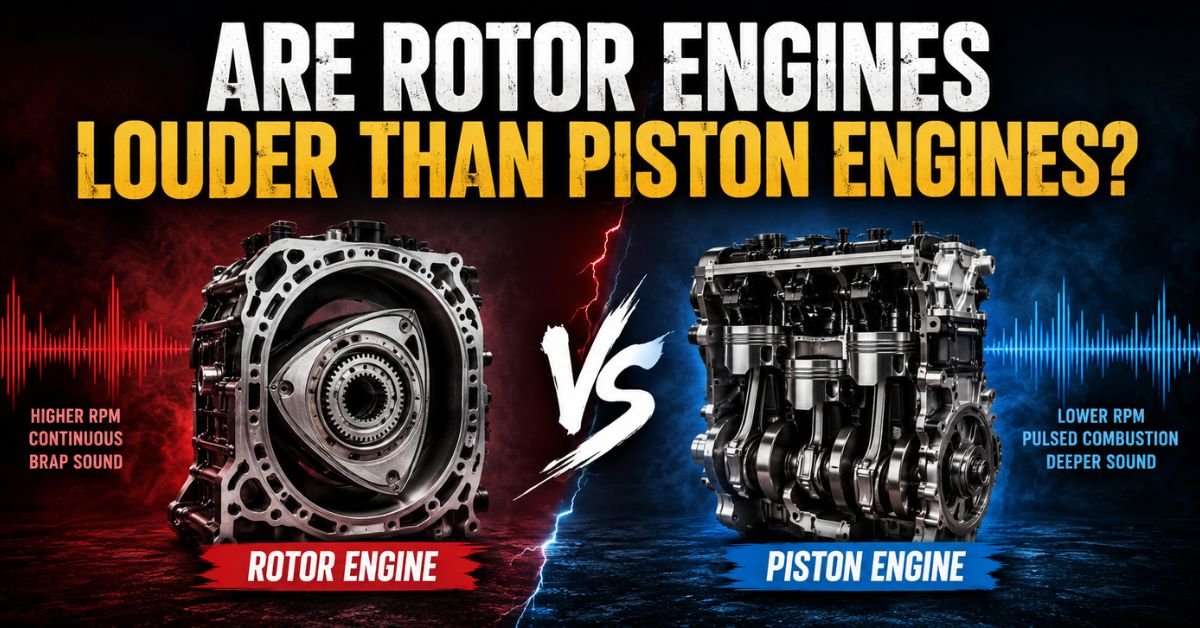
The short answer is yes, rotor engines are generally louder than traditional piston engines, but the reasons go far beyond simple volume. Their design, combustion process, exhaust flow, and operating characteristics all contribute to the distinctive sound that makes rotary-powered vehicles stand out.
In this guide, we’ll explore why rotor engines are louder, how they compare to piston engines, and what factors influence their overall noise levels.
What Is a Rotor Engine?
A rotor engine, commonly called a rotary engine, replaces conventional pistons with one or more triangular rotors that spin inside an oval-shaped housing. Instead of pistons moving up and down, the rotating motion generates power directly.
This design offers several advantages:
- Fewer moving parts
- Compact and lightweight construction
- High power-to-weight ratio
- Smooth operation with minimal vibration
- Ability to reach very high RPM
Mazda is the most well-known manufacturer to use rotary engines, with legendary models such as the RX-7 and RX-8.
What Is a Piston Engine?
A piston engine is the standard internal combustion engine found in most vehicles. It uses cylinders, pistons, connecting rods, and a crankshaft to convert fuel combustion into mechanical energy.
Piston engines are available in many configurations, including:
- Inline-four
- V6
- V8
- Boxer engines
They are renowned for being widely accessible, long-lasting, and fuel-efficient.
Are Rotor Engines Actually Louder?
In most cases, yes. Rotor engines usually produce a louder exhaust note than similarly sized piston engines.
However, loudness depends on several factors:
- Exhaust system design
- Muffler size
- Catalytic converter
- Turbocharger
- Engine tuning
- RPM
- Intake modifications
A stock rotary engine may not be dramatically louder than a stock piston engine. The biggest difference appears once performance exhaust systems are installed.
Why Are Rotor Engines Louder?
Several engineering differences contribute to the increased sound output.
1. Continuous Exhaust Pulses
Unlike piston engines that fire cylinders in alternating cycles, rotary engines create a more continuous flow of exhaust gases.
The result is:
- Faster exhaust pulses
- Higher exhaust velocity
- Sharper engine note
This continuous flow produces the distinctive high-pitched “brap” sound many enthusiasts love.
2. Higher Operating RPM
Rotary engines are famous for revving extremely high.
While many piston engines operate comfortably below 6,500 RPM, rotary engines often reach:
- 8,000 RPM
- 9,000 RPM
- Even higher in racing applications
Higher RPM naturally creates more combustion events per second, making the engine noticeably louder.
3. Minimal Internal Vibration
Rotary engines run remarkably smoothly because they lack reciprocating pistons.
Ironically, this smoothness allows more engine noise to travel through the exhaust instead of being masked by mechanical vibration.
4. Larger Exhaust Ports
Most rotary engines feature relatively large exhaust ports that allow gases to exit quickly.
This unrestricted flow creates:
- Louder exhaust tones
- More aggressive sound
- Stronger exhaust pulses
Why Do Rotor Engines Sound Different?
Many people mistake the unique rotary sound for simply being louder.
In reality, the sound differs because of:
- Different firing order
- Continuous combustion cycle
- High engine speed
- Distinct exhaust harmonics
Instead of the deep rumble of a V8 or the balanced tone of an inline-six, rotary engines produce a high-frequency, raspy exhaust note that is instantly recognizable.
What Is the Famous “Brap” Sound?
The iconic rotary “brap” is one of the most recognizable engine sounds in motorsports.
It usually occurs on modified rotary engines with:
- Peripheral porting
- Bridge porting
- Aggressive cam-style port modifications
- Performance exhaust systems
These modifications alter airflow through the engine, creating uneven combustion pulses that produce the famous popping sound.
Not every rotary engine makes this noise. Stock engines are generally much quieter.
Do Turbocharged Rotary Engines Stay Loud?
Turbochargers act as partial mufflers because exhaust gases must pass through the turbine.
A turbocharged rotary engine typically sounds:
- Slightly quieter
- Smoother
- Less raspy
However, once boost builds, the combination of turbo whistle and rotary exhaust still creates an exciting driving experience.
Must Read: How to Reprogram a Honda Key Fob After Battery Replacement?
Are Rotary Engines Louder Inside the Cabin?
Not always.
Many rotary-powered vehicles have well-insulated interiors. However, because rotary engines often operate at higher RPM, drivers may notice:
- More engine noise
- Higher exhaust resonance
- Increased intake sound
Performance exhaust upgrades can significantly increase cabin noise.
How Do Rotor Engines Compare to Piston Engines?
| Feature | Rotor Engine | Piston Engine |
|---|---|---|
| Overall Loudness | Usually louder | Generally quieter |
| Exhaust Tone | High-pitched and raspy | Deeper and smoother |
| Operating RPM | Very high | Moderate |
| Engine Vibration | Extremely low | Higher |
| Exhaust Pulses | Nearly continuous | Intermittent |
| Sound Character | Unique “rotary” note | Traditional engine sound |
Can Rotor Engines Be Made Quieter?
Yes.
Several modifications can reduce rotary engine noise:
- Larger mufflers
- High-quality resonators
- Factory-style exhaust systems
- Turbochargers
- Additional sound insulation
While these changes reduce volume, the engine’s characteristic tone usually remains.
Which Engine Sounds Better?
Sound is largely subjective.
Many enthusiasts prefer the aggressive, high-revving scream of a rotary engine, while others enjoy the deep rumble of a V8 or the refined tone of an inline-six.
Rotary engines are often favored in motorsports because their unique exhaust note is unlike almost anything else on the road.
Final Thoughts
Are piston engines quieter than rotor engines, then? The answer is usually in the affirmative. Their unique design, higher operating speeds, continuous exhaust flow, and distinctive combustion process create a louder and more recognizable sound than conventional piston engines.
However, loudness alone doesn’t define the rotary experience. The engine’s smooth operation, lightweight design, and unforgettable exhaust note are what have earned it a loyal following among automotive enthusiasts. Whether stock or modified, a rotary engine delivers a sound that is difficult to mistake for anything else, making it one of the most iconic engine designs ever produced.