
If you own a 2019 Chevy Equinox or are considering buying one, you may wonder whether it uses an Active Fuel Management (AFM) system. AFM is a technology designed to improve fuel economy by temporarily shutting down some of an engine’s cylinders when full power is not needed. Because Chevrolet has used different engine configurations and fuel-management technologies across its vehicles, the answer depends on which engine is installed in the Equinox.
Does the 2019 Chevy Equinox Have an Active Fuel Management System?
Does the 2019 Chevy Equinox Have AFM?
Yes, the 2019 Chevy Equinox can have cylinder-deactivation technology, but it depends on the engine. The 2019 Equinox was offered with several engine options, and not every engine uses the exact same fuel-management system.
The most important thing to know is that the 2.0-liter turbocharged four-cylinder engine and 1.5-liter turbocharged four-cylinder engine have different specifications and operating strategies than older GM V6 engines that are commonly associated with traditional AFM.
This distinction is important because the term “Active Fuel Management” is often used broadly when discussing GM cylinder-deactivation technology. A four-cylinder engine cannot deactivate half its cylinders in the same way a V8 can deactivate four cylinders, for example.
What Is Active Fuel Management?
Active Fuel Management is a General Motors technology designed to reduce fuel consumption during light-load driving.
On engines equipped with traditional AFM, the engine control system can deactivate specific cylinders when the vehicle does not need much power. For example, during steady highway cruising, the engine may not need to operate every cylinder at full capacity.
The system uses electronic controls and specialized engine components to stop fuel delivery and combustion in selected cylinders. When the driver needs more power, the system returns those cylinders to normal operation.
The main goal is simple: use less fuel when maximum engine power isn’t necessary.
Which Engines Were Available in the 2019 Equinox?
The 2019 Chevy Equinox was available with several engine choices depending on trim level, drivetrain, and market.
One of the common engines was the 1.5-liter turbocharged four-cylinder. There was also an available 2.0-liter turbocharged four-cylinder, while a 1.6-liter turbo-diesel four-cylinder was offered in some configurations.
Because engine availability can vary, you should check your vehicle’s engine code or VIN if you need to determine the exact technology used in a particular Equinox.
This is especially important when researching issues such as cylinder deactivation, oil consumption, lifters, or engine maintenance.
Is AFM the Same as Cylinder Deactivation?
Not necessarily.
“Active Fuel Management” is a specific GM name for a fuel-saving technology, while cylinder deactivation is a broader term describing the process of temporarily shutting down cylinders.
GM has developed several fuel-management technologies over the years. Depending on the engine, you may encounter terms such as Active Fuel Management, Dynamic Fuel Management, or other forms of variable engine operation.
As a result, simply seeing the words “fuel management” in a repair discussion doesn’t automatically mean that a particular 2019 Equinox uses the traditional AFM system found on some older GM V6 and V8 engines.
Why Does This Matter to Equinox Owners?
Knowing which engine and fuel-management system your Equinox has can be useful when diagnosing an engine problem.
Some GM engines equipped with cylinder-deactivation systems have become known for concerns involving components such as lifters, oil consumption, and valvetrain operation. However, you should not assume that every problem discussed in connection with AFM applies to every Equinox engine.
The 1.5-liter and 2.0-liter turbocharged four-cylinder engines in the 2019 Equinox have different designs from GM’s traditional AFM-equipped V6 and V8 engines.
If you are experiencing an engine-related problem, the correct diagnosis should be based on the specific engine rather than simply assuming it is an AFM problem.
Must Read: How to Replace a Sun Visor?
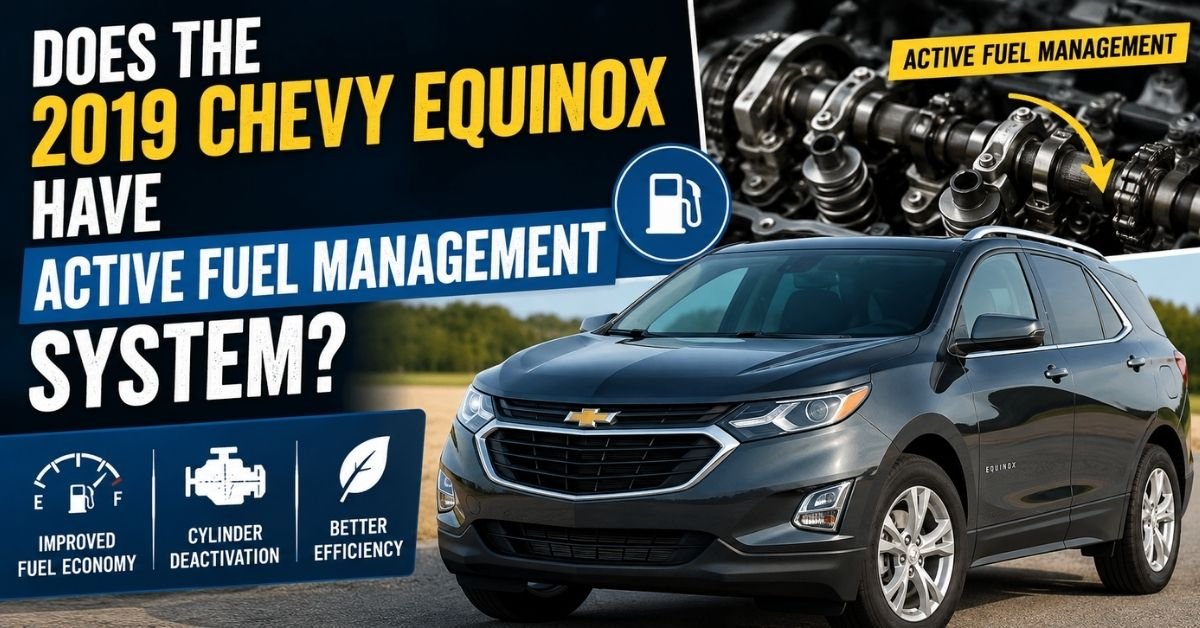
How Can You Identify Your Equinox Engine?
If you are unsure which engine your 2019 Equinox has, there are several ways to find out.
First, check your vehicle documentation. The original window sticker, owner’s documentation, or vehicle build information may identify the engine.
You can also check the VIN and use reliable vehicle information resources to determine the original engine configuration. The engine itself may also have identifying information.
Knowing the engine size is particularly useful because the 2019 Equinox was sold with multiple engine choices.
Does AFM Improve Fuel Economy?
The purpose of fuel-management technology is to improve efficiency, particularly under conditions where the engine does not need to produce much power.
At steady speeds, during light acceleration, or under other low-load conditions, an engine can potentially operate more efficiently by reducing fuel consumption. When additional power is requested, the engine management system can change its operating strategy.
However, actual fuel economy depends on many factors, including driving habits, road conditions, vehicle load, tire pressure, maintenance, weather, and whether the vehicle is equipped with front-wheel drive or all-wheel drive.
Final Thoughts
So, does the 2019 Chevy Equinox have Active Fuel Management? The answer requires some clarification. The 2019 Equinox was available with multiple engines, and the four-cylinder turbocharged engines should not simply be treated as identical to the older GM V6 and V8 engines commonly associated with traditional AFM.
If you want to know exactly what fuel-management technology your Equinox uses, start by identifying the specific engine installed in your vehicle. Your VIN, vehicle documentation, and engine information can help confirm the configuration.
Understanding the difference between AFM and other forms of cylinder or fuel management can prevent confusion when researching maintenance, engine noises, oil consumption, or potential repairs.