
When people talk about car batteries, they often ask, “How many watts does a car battery have?” It’s a reasonable question, but the answer isn’t as straightforward as a single number. That’s because car batteries are usually rated in volts and amp-hours, not watts. To truly understand the power of a car battery, you need to know how these measurements work together.
How Many Watts Are in a Car Battery?
Understanding the Basics
A typical car battery in most vehicles is a 12-volt battery. Voltage (V) represents electrical pressure, while current (amps or A) represents the flow of electricity. Watts (W), on the other hand, measure power — essentially how much energy is being used or produced at a given moment.
To calculate watts, you use a simple formula:
P = V \times I
Where:
- P = Power (watts)
- V = Voltage (volts)
- I = Current (amps)
How Much Power Can an Automobile Battery Generate?
A standard car battery doesn’t have a fixed watt rating because it depends on how much current is being drawn at any given time. However, we can estimate its power output.
For example:
- A typical car battery: 12 volts
- If a device draws 10 amps, then:
- Power = 12 × 10 = 120 watts
If the car starter motor is used, it can draw 200–400 amps or more for a short burst. That means:
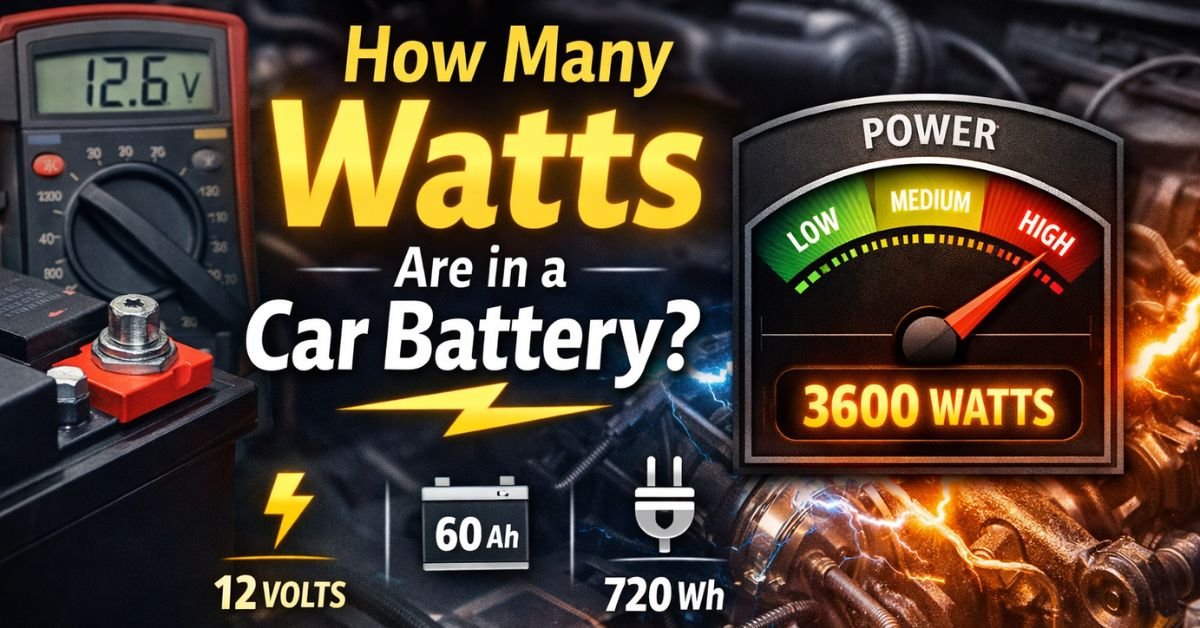
- 12 × 300 amps = 3,600 watts (3.6 kW)
So, during engine startup, a car battery can briefly deliver thousands of watts.
What About Battery Capacity?
Car batteries are often rated in amp-hours (Ah), which indicate how much energy the battery can store. A common rating is 50Ah to 70Ah.
To convert this into watt-hours (Wh), you can use:
- Watt-hours = Volts × Amp-hours
For example:
- 12V × 60Ah = 720 watt-hours
This means the battery can theoretically provide:
- 720 watts for 1 hour
- 360 watts for 2 hours
- 72 watts for 10 hours
However, in real life, efficiency losses and battery health will reduce these numbers.
Why Watts Matter in a Car Battery
Understanding watts helps you:
- Choose the right inverter if you want to power devices from your car
- Avoid overloading your battery
- Estimate how long electronics can run
For example, if you plug in a device that uses 100 watts, a fully charged 720Wh battery could run it for around 7 hours (in ideal conditions).
Must Read: How Long Can a Car Sit Before the Battery Dies?
Peak Power vs Continuous Power
It’s important to know that car batteries are designed for short bursts of high power, not long-term energy supply.
- Peak power: Used for starting the engine (very high watts for a few seconds)
- Continuous power: Much lower, used for lights, radio, and electronics
Using a car battery for long periods (like running appliances) can drain it quickly and may damage it if done repeatedly.
Real-Life Example
Let’s say you want to run a small car refrigerator that uses 60 watts:
- Battery capacity: 720Wh
- Runtime: 720 ÷ 60 = 12 hours (ideal)
In reality, you might get around 8–10 hours due to inefficiencies and battery limitations.
Key Takeaways
- Car batteries don’t have a fixed watt rating
- Watts depend on how much current is being used
- A typical 12V car battery can deliver:
- Hundreds of watts for regular use
- Thousands of watts for short bursts (engine start)
- Battery capacity is usually measured in amp-hours, which can be converted to watt-hours
Final Thoughts
What is the wattage of an automobile battery, then? The best answer is: it depends on how you use it. A standard car battery can provide anything from a few dozen watts to several thousand watts depending on the situation. Understanding this helps you make better decisions when using your car battery for electronics, travel, or backup power.