
Power inverters are incredibly useful devices that allow you to run household electronics and appliances from a vehicle, RV, boat, or backup battery system. A power inverter transforms your battery’s DC (direct current) electricity into AC (alternating current) power, which is utilized by the majority of household appliances, whether you’re charging a laptop, running tiny equipment, or powering a television.
A common question many people ask is: Will a power inverter drain my battery? The simple answer is yes, a power inverter can drain your battery, but the amount and speed depend on several factors. Understanding how power inverters work and how they consume energy can help you avoid unexpected battery problems.
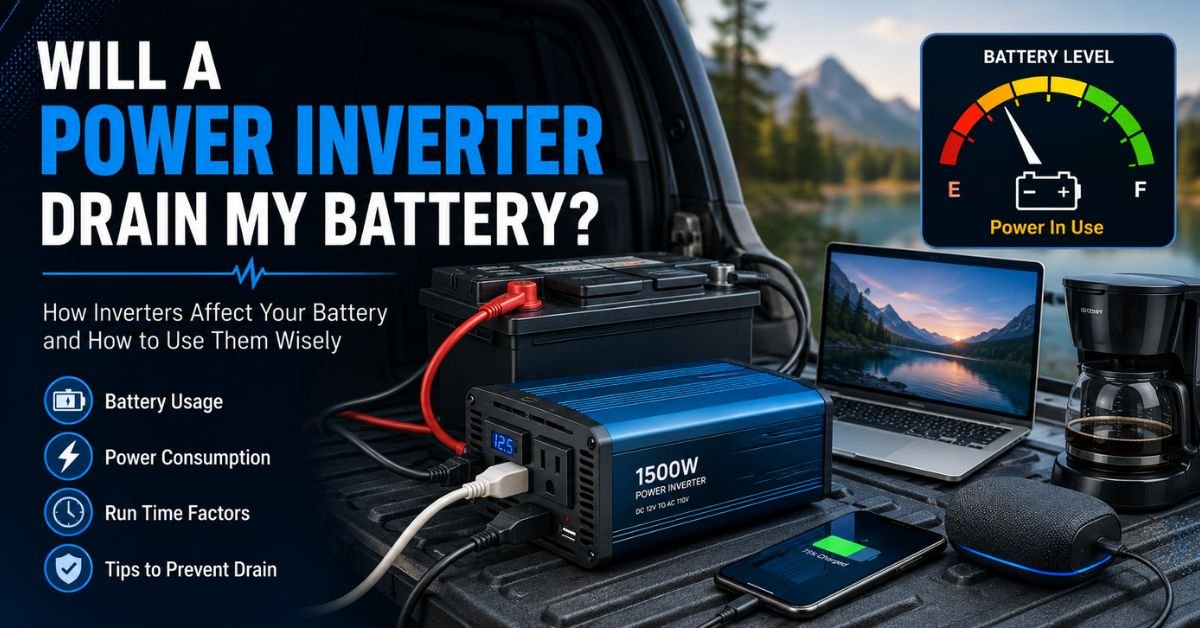
Will a Power Inverter Drain My Battery?
How Does a Power Inverter Use Battery Power?
A power inverter doesn’t create electricity. Instead, it draws power directly from the battery and converts it into usable AC power. Every device connected to the inverter requires energy, and that energy ultimately comes from the battery.
For example, if you connect a 100-watt laptop charger to a power inverter, the inverter must pull enough power from the battery to supply those 100 watts. Because inverters are not 100% efficient, they typically consume a little more power than the connected device requires.
Most power inverters operate at around 85% to 95% efficiency. This means some battery power is lost during the conversion process as heat.
Can a Power Inverter Drain a Battery When Nothing Is Plugged In?
Yes. Even when no devices are connected, many power inverters continue to draw a small amount of power from the battery. This is known as the inverter’s “idle” or “standby” consumption.
While the power draw is usually low, leaving an inverter switched on for several days can slowly discharge a battery. High-capacity inverters often have higher standby power consumption than smaller models.
If you’re not using the inverter, it’s a good idea to turn it off to minimize battery drain.
How Fast Will an Inverter Drain a Car Battery?
The speed at which a power inverter drains a battery depends on:
- Battery capacity
- Power rating of connected devices
- Inverter efficiency
- Battery condition
- Whether the engine is running
For example, a typical car battery may have a capacity of around 50 to 70 amp-hours. Running a 150-watt appliance through an inverter could significantly reduce the battery charge within a few hours if the engine is off.
A larger appliance, such as a microwave or coffee maker, can drain the battery much faster. In some cases, using high-powered devices without the engine running can leave you with insufficient battery power to start the vehicle.
Does the Engine Running Prevent Battery Drain?
When the vehicle’s engine is running, the alternator generates electricity and recharges the battery. In many situations, the alternator can supply enough power to offset the inverter’s consumption.
However, if the connected appliance requires more power than the alternator can provide, the battery may still discharge gradually.
For light loads such as charging phones, tablets, or laptops, a running engine typically prevents significant battery drain. For heavy loads, monitoring battery voltage is recommended.
Power Inverters in RVs and Solar Systems
Power inverters are commonly used in RVs, camper vans, and solar energy systems. In these setups, larger deep-cycle batteries are often installed specifically to handle repeated charging and discharging.
Even with larger battery banks, an inverter can still drain the batteries if energy usage exceeds available charging from solar panels, generators, or shore power.
RV owners often monitor battery levels carefully to ensure they have enough power for lighting, appliances, and essential systems.
Must Read: How to Find If a Chevy Bolt Has Had Its Battery Replaced?
How to Reduce Battery Drain From a Power Inverter
If you use a power inverter regularly, there are several ways to reduce battery drain:
Turn Off the Inverter When Not Needed
Over time, even standby power consumption increases. Switching off the inverter when not in use is one of the easiest ways to preserve battery life.
Use Energy-Efficient Devices
LED lights, laptops, and modern electronics generally consume less power than older equipment, helping extend battery runtime.
Monitor Battery Voltage
A battery monitor or voltmeter can help you track battery charge levels and avoid excessive discharge.
Run the Engine Periodically
When using an inverter in a vehicle, running the engine periodically allows the alternator to recharge the battery.
Upgrade to a Larger Battery
If you frequently use an inverter, a higher-capacity battery or deep-cycle battery may provide longer runtimes and better performance.
Signs Your Battery Is Being Overdrained
Watch for these warning signs:
- Slow engine cranking
- Dim vehicle lights
- Low battery voltage readings
- Inverter shutting down unexpectedly
- Battery warning lights on the dashboard
These symptoms may indicate that the battery charge has dropped too low.
Final Thoughts
So, will a power inverter drain your battery? Absolutely. Every power inverter draws energy from the battery, whether it’s powering devices or simply remaining switched on in standby mode. The size of the inverter, the connected devices, and the battery’s capacity all affect how quickly the battery drains.
For occasional use, especially with the engine running, battery drain is usually manageable. However, prolonged use with the engine off can quickly deplete a vehicle battery and may leave you unable to start the engine. By monitoring power consumption, turning the inverter off when not needed, and maintaining a healthy battery, you can enjoy the convenience of a power inverter without unexpected battery issues.